Checked
History of Vancouver: from Musqueam, Squamish and Tsleil-Waututh lands to today
Vancouver, British Columbia, Canada
The history of Vancouver, British Columbia: the Musqueam, Squamish and Tsleil-Waututh Nations, Gastown, the 1886 founding and fire, the railway, hard chapters, Expo 86 and recent milestones, with a timeline.
Key information
Vancouver is on the unceded territories of the Musqueam, Squamish and Tsleil-Waututh Nations, who have lived here since time immemorial. The city grew from Gastown, a sawmill settlement of the 1860s, and was incorporated on April 6, 1886, when the Canadian Pacific Railway made it its Pacific terminus.
On this page
Whose land is Vancouver on?
The City of Vancouver states that it is situated on the unceded traditional territories of the xʷməθkʷəy̓əm (Musqueam), Sḵwx̱wú7mesh Úxwumixw (Squamish Nation) and səlilwətaɬ (Tsleil-Waututh) Nations, the hən̓q̓əmin̓əm̓ and Sḵwx̱wú7mesh speaking peoples who have stewarded this place since time immemorial.
Unceded means the land was never given up to the Crown through a treaty or other agreement. The City says the word recognizes the dispossession of the land and the inherent rights the three Nations hold, and that they have never left their territories.
Archaeologists date ancestral settlement in the area to more than 8,000 years ago. Salmon was the core of a rich economy that also drew on shellfish, game and plants. Large villages stood at places such as c̓əsnaʔəm, the Marpole Midden on the Fraser River, and X̱wáýx̱way, near today's Lumberman's Arch in Stanley Park, home to hundreds of people.
Most of British Columbia, including Vancouver, was never covered by a historic treaty. In 1859 the colony simply proclaimed the land to belong to the Crown.
Sources: City of Vancouver: Land acknowledgement · City of Vancouver: Indigenous communities · The Canadian Encyclopedia: Vancouver · The Canadian Encyclopedia: Stanley Park
How did Vancouver start?
European sailors arrived in 1791 and 1792: first the Spanish explorer José María Narváez, then Captain George Vancouver with the Spanish captains Galiano and Valdés. For decades the area stayed on the edge of the fur trade.
Sawmills on Burrard Inlet in the 1860s brought a small workforce. In September 1867, John "Gassy Jack" Deighton landed at a place the Coast Salish called Lek'leki, a grove of trees on the old portage route to False Creek, and opened a saloon. The cluster of buildings that grew around it was surveyed in 1870 as Granville Townsite, though everyone called it Gastown. Many early settlers, Deighton included, had Indigenous wives.
Sources: The Canadian Encyclopedia: Vancouver · The Canadian Encyclopedia: Gastown
When was Vancouver founded, and how did it get its name?
The Canadian Pacific Railway planned to end its line at Port Moody, but CPR head William Van Horne chose to extend it to Granville for a better harbour. The province gave the railway more than 2,500 hectares of Crown land. Van Horne also wanted a grander name, and suggested Vancouver after the explorer.
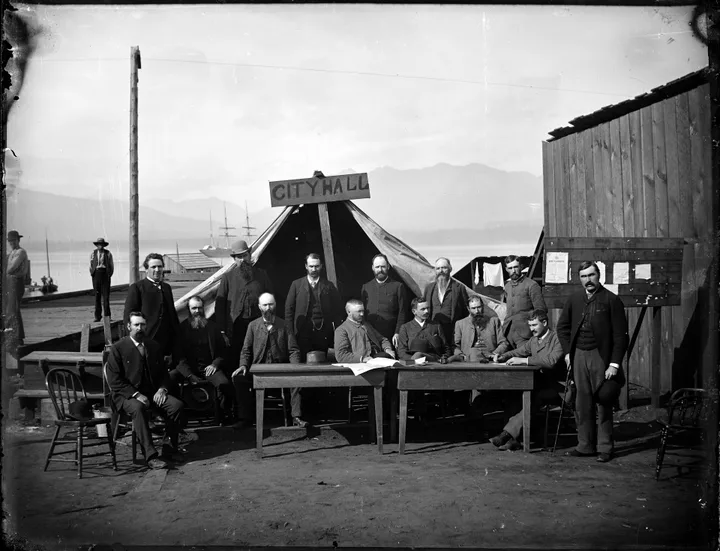
The provincial legislature incorporated the City of Vancouver on April 6, 1886, and real-estate dealer Malcolm MacLean became the first mayor. On June 13, a CPR land-clearing fire raced out of control and burned the town. Accounts of the dead range from at least 11 to dozens. Council met in a tent, residents rebuilt at once, and the first transcontinental passenger train arrived on May 23, 1887.
Sources: The Canadian Encyclopedia: Vancouver · BC Geographical Names: Vancouver · The Canadian Encyclopedia: Gastown
How did Vancouver grow?
- 1921117,217 people
- 1931246,593 people
- 1941275,353 people
- 1951344,833 people
- 1961384,522 people
- 1971426,256 people
- 1981414,281 people
- 1991471,844 people
- 2001545,671 people
- 2011603,502 people
- 2021662,248 people
Stanley Park opened on September 27, 1888. To build its road, city crews destroyed the remaining houses at X̱wáýx̱way and evicted the residents; the Park Board later went to court to remove other families. The Klondike Gold Rush of 1897 to 1898 brought prosperity, and by 1900 Vancouver had passed Victoria as the West Coast's leading business centre.
In the 1920s Vancouver passed Winnipeg as the biggest city in Western Canada, helped by grain exports through the Panama Canal. In 1929 it merged with the neighbouring municipalities of South Vancouver and Point Grey, which roughly doubled the census count between 1921 and 1931. During the Depression, Mayor Gerry McGeer read the Riot Act to unemployed protesters in 1935, and pushed through the new City Hall, which opened on December 4, 1936.
War industries such as shipbuilding ended unemployment in the 1940s. Later decades brought high-rise towers in the West End and downtown, and a booming port.
Sources: The Canadian Encyclopedia: Vancouver · The Canadian Encyclopedia: Stanley Park · City of Vancouver: Architecture of City Hall · BC Stats: Municipal census populations, 1921 to 2021
What hard chapters should newcomers know about?
Asian residents faced open racism in the city's early decades: an anti-Chinese riot in 1887, an anti-Asian riot in 1907, and the Komagata Maru in 1914, when 376 passengers from British India, most of them Punjabi Sikhs, were held on their ship in the harbour for two months and then sent away. In 2021 the City apologized and made May 23 a day of remembrance, now called Guru Nanak Jahaz (Komagata Maru) Remembrance Day.
In 1942 Japanese Canadians were forced from the coast. Many were first held at the Hastings Park exhibition grounds, and about 8,600 Vancouver residents had their property seized and sold.
Hogan's Alley, the centre of Vancouver's Black community near Strathcona, was levelled from 1967 for a freeway plan. Protests from Chinatown and Strathcona residents later stopped the freeway, which is why no freeway runs through the city today.
Sources: The Canadian Encyclopedia: Vancouver · The Canadian Encyclopedia: Komagata Maru (Guru Nanak Jahaz) · The Canadian Encyclopedia: Hogan's Alley
Which historic places still stand?
- Gastown, the original settlement, now a National Historic Site, with its 1977 Steam Clock at Water and Cambie streets.
- Stanley Park (opened 1888) and its seawall, begun in 1917 and finished around the park on September 21, 1980.
- Vancouver City Hall, 453 West 12th Avenue (1936), an Art Deco and Moderne landmark designated heritage in 1976. The lobby and Council Chamber are open to visitors on weekdays.
- Lions Gate Bridge, officially opened May 29, 1939.
- Expo 86 legacies: Science World's dome, BC Place and Canada Place.
Sources: The Canadian Encyclopedia: Gastown · City of Vancouver: Seawall in Vancouver · City of Vancouver: Architecture of City Hall · The Canadian Encyclopedia: Lions Gate Bridge · The Canadian Encyclopedia: Expo 86
What has happened since Expo 86?
Expo 86 opened on May 2, 1986, and drew more than 20 million visits; SkyTrain began running that January. The former industrial shores of False Creek filled with towers, and the 2010 Winter Olympics left the Athletes' Village. In 2003, the Downtown Eastside became home to North America's first supervised injection site.
In 2014, Council adopted a Reconciliation Framework, declared Vancouver a City of Reconciliation and acknowledged that the city is on unceded Musqueam, Squamish and Tsleil-Waututh territory. The City says it was the first government in Canada to do so. Since then it returned land at c̓əsnaʔəm to Musqueam (2018), gave two downtown plazas hən̓q̓əmin̓əm̓ and Sḵwx̱wú7mesh names (2018), and passed a UNDRIP Strategy with 79 calls to action (2022) and an action plan (2024) developed with the three Nations. In 2022 the City and the Squamish Nation signed a services agreement for the Nation's Sen̓áḵw development, which the City says it supports as the Nation's right.
In 2026, BC Place hosted seven FIFA World Cup matches, and the Broadway Subway is due to open in fall 2027.
Sources: The Canadian Encyclopedia: Expo 86 · The Canadian Encyclopedia: Vancouver · City of Vancouver: Vancouver's journey towards Reconciliation · City of Vancouver: City of Reconciliation · FIFA: BC Place Vancouver at the FIFA World Cup 2026 · Government of B.C.: Broadway Subway Project reaches major milestone (September 21, 2026)
Vancouver history timeline
| Year | Event |
|---|---|
| Time immemorial | Musqueam, Squamish and Tsleil-Waututh peoples live on and care for these lands and waters. Ancestors of these groups settled the area more than 8,000 years ago. |
| 1791 to 1792 | Spanish explorer José María Narváez, then Captain George Vancouver and Spanish captains Galiano and Valdés, sail into the area. |
| 1808 | Simon Fraser of the North West Company ends his trip down the Fraser River near the present Marine Drive. |
| 1859 | The colony proclaims the land Crown land without negotiating with the Nations. The Stanley Park peninsula is set aside as a reserve. |
| 1867 | John "Gassy Jack" Deighton opens a saloon near the Hastings sawmill. The settlement becomes known as Gastown. |
| 1870 | The settlement is surveyed as Granville Townsite. |
| 1886 | April 6: the City of Vancouver is incorporated. June 13: the Great Fire destroys the town. |
| 1887 | May 23: the first transcontinental train reaches Vancouver. Crews destroy the village of X̱wáýx̱way in the park to build Park Road. |
| 1888 | September 27: Stanley Park opens. |
| 1907 | An anti-Asian riot breaks out in Vancouver. |
| 1914 | The Komagata Maru (Guru Nanak Jahaz), carrying 376 passengers from British India, is kept from landing for two months. |
| 1915 | The Vancouver Millionaires win the Stanley Cup. |
| 1917 | Work begins on the Stanley Park seawall. |
| 1929 | Vancouver merges with South Vancouver and Point Grey. |
| 1936 | December 4: the new City Hall opens at 12th and Cambie. |
| 1939 | May 29: the Lions Gate Bridge officially opens. |
| 1942 | Japanese Canadians are uprooted from the coast; about 8,600 from Vancouver lose their property. |
| 1967 | The City begins levelling Hogan's Alley, the heart of Vancouver's Black community. A planned freeway through Chinatown is later cancelled after protests. |
| 1971 | Greenpeace sails from Vancouver on its first protest voyage. |
| 1980 | September 21: the seawall loop around Stanley Park is completed. |
| 1986 | January 3: SkyTrain service begins. May 2 to October 13: Expo 86 draws 20.1 million visits. |
| 2003 | North America's first supervised injection site opens in the Downtown Eastside. |
| 2010 | Vancouver hosts the Olympic and Paralympic Winter Games. |
| 2014 | Council declares Vancouver a City of Reconciliation and acknowledges the city is on unceded Musqueam, Squamish and Tsleil-Waututh territory. |
| 2018 | The City returns land at the c̓əsnaʔəm (Marpole Midden) site to the Musqueam Indian Band. |
| 2021 | The City apologizes for its role in the Komagata Maru incident and makes May 23 a day of remembrance. |
| 2022 | Council passes a UNDRIP Strategy with 79 calls to action, developed with the three Nations. |
| 2026 | BC Place hosts seven FIFA World Cup matches, including Canada's first World Cup win. |
| 2027 | The Broadway Subway is scheduled to open in the fall. |
Sources: The Canadian Encyclopedia: Vancouver · BC Geographical Names: Vancouver · City of Vancouver: Vancouver's journey towards Reconciliation · The Canadian Encyclopedia: Komagata Maru (Guru Nanak Jahaz) · The Canadian Encyclopedia: Expo 86 · The Canadian Encyclopedia: SkyTrain
10 questions about Vancouver history
When was Vancouver founded?
The City of Vancouver was incorporated on April 6, 1886. The settlement before it, Gastown or Granville, dates from 1867 to 1870.
Who were the first people in Vancouver?
The Musqueam, Squamish and Tsleil-Waututh peoples, whose ancestors settled the area more than 8,000 years ago.
What does unceded mean in Vancouver?
It means the Musqueam, Squamish and Tsleil-Waututh Nations never gave up their land to the Crown through a treaty or other agreement.
Why was Vancouver built where it is?
The Canadian Pacific Railway extended its line from Port Moody to Granville for a better deep-water harbour, and the city grew around the terminus.
What was the Great Vancouver Fire?
A CPR land-clearing fire that burned the new city on June 13, 1886. At least 11 people died; some accounts say dozens.
When did the first train arrive in Vancouver?
The first train arrived on May 23, 1887.
Source: BC Geographical Names: Vancouver
When did Vancouver become a City of Reconciliation?
City Council adopted the Reconciliation Framework on July 8, 2014.
What happened to the Komagata Maru?
In 1914 the ship and its 376 passengers from British India were kept from landing in Vancouver for two months and sent back. The City apologized in 2021.
Source: The Canadian Encyclopedia: Komagata Maru (Guru Nanak Jahaz)
What was Hogan's Alley?
A neighbourhood near Strathcona that was the centre of Vancouver's Black community until the City began levelling it in 1967 for a freeway project.
When did Vancouver amalgamate with South Vancouver and Point Grey?
In 1929, which helped Vancouver become the biggest city in Western Canada.