Checked
About Vancouver: a newcomer and visitor guide
Vancouver, British Columbia, Canada
What to know about Vancouver, British Columbia: where it is, how many people live there, its 22 neighbourhoods, transit, jobs, weather, hospitals, schools and landmarks.
Key information
Vancouver is a city of 662,248 people (2021 Census) on a peninsula between Burrard Inlet and the Fraser River, on the unceded territories of the Musqueam, Squamish and Tsleil-Waututh Nations. It is the largest city in British Columbia, the most densely populated large city in Canada, and the centre of a metro area of 2.64 million people.
On this page
Where is Vancouver?
Vancouver sits on a peninsula in the southwest corner of British Columbia's mainland. Burrard Inlet and the North Shore mountains lie to the north, English Bay and the Strait of Georgia to the west, and the North Arm of the Fraser River to the south. Burnaby is the neighbour to the east.
The City of Vancouver is the core of the Metro Vancouver region. The City itself covers 115.18 square kilometres. Many places people call "Vancouver" are actually next door: the airport (YVR) is in Richmond, and the University of British Columbia campus at Point Grey is outside the City's boundaries.
The City acknowledges that it is on the unceded traditional territories of the xʷməθkʷəy̓əm (Musqueam), Sḵwx̱wú7mesh Úxwumixw (Squamish Nation) and səlilwətaɬ (Tsleil-Waututh) Nations. Unceded means the land was never given up to the Crown by treaty or any other agreement. The History of Vancouver guide explains more.
Sources: The Canadian Encyclopedia: Vancouver · Statistics Canada: Population and dwelling counts, 2021 Census (table 98-10-0002-01) · City of Vancouver: Land acknowledgement
How many people live in Vancouver?
| Measure | Number |
|---|---|
| Population, 2021 Census | 662,248 |
| Population, 2016 Census | 631,486 |
| Growth, 2016 to 2021 | 4.9% |
| Land area | 115.18 km² |
| People per km², 2021 | 5,749.9 |
| Metro area population, 2021 | 2,642,825 |
| BC Stats estimate, July 1, 2025 | 740,454 |
The 2021 Census counted 662,248 people in the City of Vancouver, up 4.9% from 631,486 in 2016. That makes it the largest city in British Columbia and the eighth largest in Canada. The wider Vancouver metro area had 2,642,825 people.
Vancouver is crowded in a way few Canadian cities are. With 5,749.9 people per square kilometre, it had the highest population density of any Canadian city of 100,000 or more in 2021, ahead of Montreal (4,833.5) and Toronto (4,427.8).
BC Stats estimates the City had 740,454 residents on July 1, 2025. That is a provincial estimate, not a census count, and it was slightly lower than the 2024 estimate of 748,788.
Sources: Statistics Canada: Population and dwelling counts, 2021 Census (table 98-10-0002-01) · BC Stats: Population estimates for B.C. municipalities · The Canadian Encyclopedia: Vancouver
What are the main neighbourhoods of Vancouver?
| Area | Area | Area |
|---|---|---|
| Arbutus-Ridge | Downtown | Dunbar-Southlands |
| Fairview | Grandview-Woodland | Hastings-Sunrise |
| Kensington-Cedar Cottage | Kerrisdale | Killarney |
| Kitsilano | Marpole | Mount Pleasant |
| Oakridge | Renfrew-Collingwood | Riley Park |
| Shaughnessy | South Cambie | Strathcona |
| Sunset | Victoria-Fraserview | West End |
| West Point Grey |
For planning and statistics, the City divides Vancouver into 22 local areas. The City notes that people do not always agree on neighbourhood names and edges, so you will also hear smaller names like Gastown, Yaletown, Chinatown, Commercial Drive or Coal Harbour.
Downtown and the West End fill the peninsula next to Stanley Park. Strathcona, the city's oldest residential area, sits just east of downtown. Kitsilano, Fairview and Mount Pleasant line the south shore of False Creek. The east side (Grandview-Woodland, Hastings-Sunrise, Renfrew-Collingwood, Kensington-Cedar Cottage) and the south (Sunset, Victoria-Fraserview, Killarney, Marpole) were largely separate suburbs until the 1929 merger with South Vancouver and Point Grey.
Sources: City of Vancouver: Areas of the city · The Canadian Encyclopedia: Vancouver
How do people get around Vancouver?
TransLink runs buses, the SeaBus ferry to North Vancouver and SkyTrain. SkyTrain opened in 1986 as the world's first driverless urban rail system, and Vancouver is served by all three lines: the Expo Line, the Millennium Line and the Canada Line to Richmond and the airport.
The Broadway Subway, a 5.7 km Millennium Line extension under Broadway with six underground stations, is scheduled to open for passengers in fall 2027, according to the Province.
Walking and cycling are popular because the city is compact. The 28 km seaside path from the Vancouver Convention Centre to Spanish Banks, including the Stanley Park Seawall, has separate lanes for walkers and for cyclists. There are no freeways through the city: plans for one were dropped after protests in the late 1960s.
Sources: The Canadian Encyclopedia: SkyTrain · Government of B.C.: Broadway Subway Project reaches major milestone (September 21, 2026) · City of Vancouver: Seawall in Vancouver · The Canadian Encyclopedia: Vancouver
What is the economy like, and who are the big employers?
Vancouver grew up as a railway and port town, and trade is still central. The Canadian Encyclopedia reports that the Port of Vancouver has ranked first among Canadian ports by tonnage since 1963, and the city is Canada's main hub for trade with Asia. All of Canada's major banks have offices here.
In the 2021 Census, the largest number of Vancouver residents worked in professional, scientific and technical services, followed by health care and social assistance, retail and education. Film and television production is big enough to earn the nickname "Hollywood North," and tourism, cruise ships to Alaska, technology, digital media and mining company head offices add to the mix.
Large public employers include the health authorities that run the city's hospitals, the City of Vancouver, and universities and colleges. We did not find a current official ranking of the city's biggest employers, so none is shown here.
Sources: The Canadian Encyclopedia: Vancouver
What is the weather like in Vancouver?
- Jan168 mm
- Feb105 mm
- Mar114 mm
- Apr89 mm
- May65 mm
- Jun54 mm
- Jul36 mm
- Aug37 mm
- Sep51 mm
- Oct121 mm
- Nov189 mm
- Dec162 mm
| Measure | January | July | Year |
|---|---|---|---|
| Daily average temperature | 4.1°C | 18.0°C | 10.4°C |
| Average daily high | 6.9°C | 22.2°C | 13.9°C |
| Average daily low | 1.4°C | 13.7°C | 6.8°C |
| Precipitation | 168 mm | 36 mm | 1,189 mm |
| Snowfall | 11 cm | 0 cm | 38 cm |
| Days with 0.2 mm or more of precipitation | 19.5 | 6.3 | 169 |
Vancouver has the mildest winters of any big Canadian city, and a lot of rain to go with them. At the Vancouver International Airport weather station (on Sea Island in Richmond), the daily average is 4.1°C in January and 18.0°C in July and August, based on 1981 to 2010 normals.
About 1,189 mm of precipitation falls in an average year, and it is very seasonal: November averages 189 mm, July only 36 mm. Snow is light, around 38 cm a year, but it can snarl traffic when it comes. Summers are dry and sunny, with about 290 hours of bright sunshine in July.
Sources: Environment and Climate Change Canada: Climate normals 1981 to 2010, Vancouver Int'l A
What languages are spoken in Vancouver?
English is the everyday language of business and city services. Vancouver is also one of the most diverse cities in Canada: in the 2021 Census, people of Chinese origin were the largest ethnic group at 24.5% of the population, followed by English (13%), Scottish (10.6%) and Irish (10.1%) origins.
Across Metro Vancouver in 2021, 70% of residents spoke English most often at home, followed by Mandarin (6%), Punjabi (6%), Cantonese (5%) and Korean (2%), according to the City of Surrey's census profile of the region. Since 2018 some downtown plazas carry names in hən̓q̓əmin̓əm̓ and Sḵwx̱wú7mesh, the languages of the Host Nations.
Sources: The Canadian Encyclopedia: Vancouver · City of Vancouver: Vancouver's journey towards Reconciliation · City of Surrey: 2021 Census profile (includes Metro Vancouver figures)
Where are the main hospitals and schools?
- Vancouver General Hospital, 899 West 12th Avenue: a large teaching hospital affiliated with UBC with full emergency services.
- St. Paul's Hospital, downtown on Burrard Street. A new St. Paul's Hospital at False Creek Flats, near Main Street-Science World Station, is expected to open in early 2027.
- BC Children's Hospital: the province's only dedicated pediatric hospital, serving about 270,000 visits a year.
- Post-secondary schools in the city include Langara College, Vancouver Community College, Emily Carr University of Art and Design and Simon Fraser University's downtown campus. UBC (founded 1908) is just west of the city line at Point Grey.
Sources: Vancouver Coastal Health: Vancouver General Hospital · St. Paul's Foundation: The Jim Pattison Medical Campus · BC Children's Hospital: About us · The Canadian Encyclopedia: Vancouver
What is Vancouver known for?
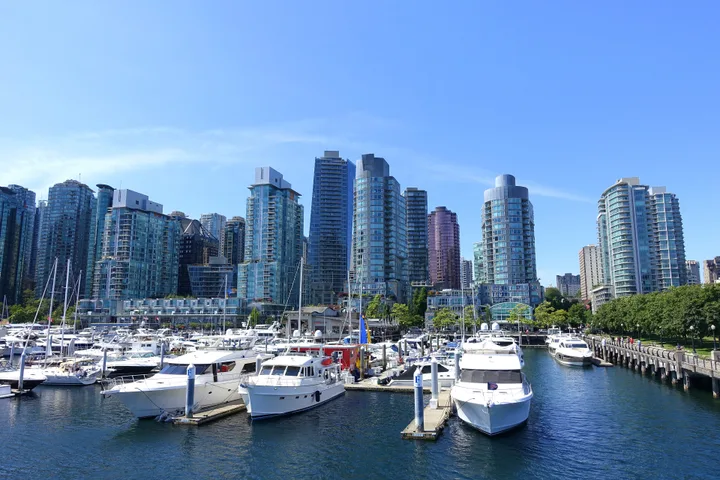
Mountains and ocean in the same view, first of all. Stanley Park, the city's first and largest park, is a 400-hectare forest on the edge of downtown, ringed by the seawall. Granville Island, Gastown, Chinatown, Science World (the geodesic dome left from Expo 86), Canada Place and the Lions Gate Bridge are the other postcard stops.
The city is also known for hosting Expo 86, the 2010 Winter Olympics and matches of the 2026 FIFA World Cup, for being the birthplace of Greenpeace, for its film industry, and for some of the highest home prices in Canada.
Sources: City of Vancouver: Stanley Park · The Canadian Encyclopedia: Vancouver · The Canadian Encyclopedia: Expo 86 · Greenpeace Canada: Our history · FIFA: BC Place Vancouver at the FIFA World Cup 2026
10 useful questions about Vancouver
What is the population of Vancouver?
The 2021 Census counted 662,248 people in the City of Vancouver, and BC Stats estimated 740,454 on July 1, 2025. The metro area had 2,642,825 people in 2021.
Source: Statistics Canada: Population and dwelling counts, 2021 Census (table 98-10-0002-01)
Is Vancouver the capital of British Columbia?
No. Victoria, on Vancouver Island, is the capital. Vancouver is the province's largest city and its main business centre.
Is Vancouver on Vancouver Island?
No. The City of Vancouver is on the mainland. Vancouver Island lies across the Strait of Georgia to the west; both are named after Captain George Vancouver.
Source: BC Geographical Names: Vancouver
How many neighbourhoods does Vancouver have?
The City officially divides Vancouver into 22 local areas, from Arbutus-Ridge to the West End. People also use many smaller names such as Gastown and Yaletown.
Whose land is Vancouver on?
The City of Vancouver acknowledges that it is on the unceded traditional territories of the Musqueam, Squamish and Tsleil-Waututh Nations.
How much does it rain in Vancouver?
About 1,189 mm of precipitation falls in an average year at the airport, with roughly 169 wet days. November is the wettest month and July the driest.
Source: Environment and Climate Change Canada: Climate normals 1981 to 2010, Vancouver Int'l A
Does it snow in Vancouver?
A little. The airport station averages about 38 cm of snow a year, mostly in December and January, and many winters see only a few snowy days.
Source: Environment and Climate Change Canada: Climate normals 1981 to 2010, Vancouver Int'l A
Where is Vancouver airport?
Vancouver International Airport (YVR) is on Sea Island in Richmond, just south of the city. The Canada Line SkyTrain connects it to downtown.
What is Vancouver known for?
Its setting between mountains and ocean, Stanley Park and the seawall, a large film industry, the port, Expo 86 and the 2010 Winter Olympics.
When does the Broadway Subway open?
The Province says the 5.7 km extension under Broadway, with six stations, is scheduled to open for passenger service in fall 2027.
Source: Government of B.C.: Broadway Subway Project reaches major milestone (September 21, 2026)